Peaks of the Pyrenees
The hidden valleys trail
The Pyrenees have long been a beloved setting for classic rallies. The mountain range, which forms the natural border between France and Spain, is renowned for its spectacular mountain passes, quiet country roads, and breathtaking landscapes. As early as the first half of the twentieth century, motorists ventured to this region to experience the technical roads and varied terrain.
What makes the Pyrenees particularly special for classic rallies is the combination of driving challenge and natural beauty. The roads wind through deep valleys, past mountain lakes, and through small villages where time seems almost to stand still. Passes such as the Col du Tourmalet and the Col d’Aubisque are famed among both cyclists and motorists for their dramatic hairpin bends and panoramic views.
Today, the region still hosts regular classic rallies and touring events. These focus not only on speed, but also on navigation, driving skill, and enjoying the scenery. The combination of quiet roads, historic villages, and rugged nature makes the Pyrenees one of the most beautiful rally areas in Europe. For participants in classic cars, driving through this mountain landscape is not just a competition, but a journey through history, engineering, and nature.

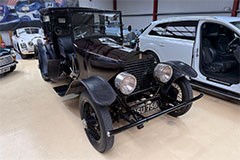
We first gather at a remarkable private collection that houses the largest private collection of Rolls-Royce cars in Europe. After lunch and a look around the collection, we drive to the first hotel of the rally, located in the centre of Pamplona.
The following morning the rally itself begins. Soon after leaving Pamplona we climb into the Pyrenees, crossing from Spain into France and driving along high mountain roads before reaching our first overnight stop at altitude.
During the following days the route becomes a succession of mountain passes: some higher, some steeper, but each with its own character. Gradually we move eastwards through the French Pyrenees. In France days the route follows smaller roads through gorges and valleys, allowing us to explore quieter parts of this beautiful region.
Later in the rally we cross back into Spain for more mountain driving, including a remarkable narrow gorge road that runs high above the river below. After nine days on the road we return to Bilbao for the final dinner and prize awarding,
As always with the rallies organised by Via Flaminia, this is a relaxed rally where competition serves the atmosphere, winning is not an end in itself. Those who want coffee along the way can do so. No time restriction. Of course, we do expect you in time for lunch and dinner. Classification is done by navigation and competition for last place is sometimes fierce. There are 30 places available for cars up to 1945.
For teams whose added age is under 100, there is a discount of 1% for each year less then 100, with a maximum of 15% (reference year 2026).
Arrival of ferry from Plymouth to Santander.
Those arriving on the ferry from Portsmouth to Bilbao will arrive at around eight o’clock in the morning, in time for a short drive to the welcome gathering, which will be held at one of the largest Rolls-Royce collections in the world. The friendly family who owns the collection will welcome us with a splendid lunch, prepared by Almudena Gandarias, who won Master Chef “Grannies” Edition, and give us a tour of their remarkable cars.
From there, it is a straightforward drive of 180km, mostly along the motorway, to the five star hotel, located on the central square of Pamplona. In a nearby bar, we will host a welcome drink, after which you are free to explore this wonderful city, with its wide variety of restaurants and tapas bars, at your own pace.
The following morning, we will gather for the start of the rally.
For the first day of the rally, we leave Pamplona and head towards the mountains. The road gradually climbs and, after lunch, we encounter the majesty of the Pyrenees for the first time as we cross into France over the Col de la Pierre-Saint-Martin. From here the route winds through dramatic mountain scenery, following undulating roads with splendid views of bare peaks and dense forests.
Continuing through this spectacular landscape, we eventually cross the border back into Spain, where we will spend the night at the historic five star Canfranc Estación. Opened in 1928, the station was once one of the largest and most impressive railway stations in Europe, built to connect Spain and France through the Pyrenees. With its grand façade stretching more than 200 metres and hundreds of windows and doors, it was often referred to as the “Titanic of the Mountains”.
After decades of decline following the closure of the international rail link in 1970, the remarkable building has recently been restored and transformed into a luxurious five-star hotel. Tonight we will stay in this beautifully restored historic station, where the elegance of the past has been carefully combined with modern comfort.
Unfortunately, we have to leave our very comfortable hotel, but today’s drive promises to be truly exhilarating. We first cross back into France. The day begins gently, with a straightforward road heading north as we follow a river downstream through a broad valley; easy and relaxing driving with the mountains rising around us.
Before long we turn eastwards and, almost without noticing, the road begins to climb again into the Pyrenees. This time the driving becomes more demanding. Our first major pass of the day is the Col d’Aubisque, reaching an altitude of 1,709 metres. From here the route continues over the Col du Soulor, and the scenery becomes increasingly dramatic. At times the road narrows as it traces the mountainside, but the views across the high Pyrenean landscape are simply magnificent.
Descending once more, we follow the valley towards Lourdes before turning south again and climbing back into the mountains. Two more classic Pyrenean passes await us: the Col de Val Louron-Azet and the Col d’Aspin, both offering sweeping bends, open mountain pastures and wonderful panoramic views.
We will spend the night beside a beautiful mountain lake, at the foot of the pass that will challenge us the following morning.
We continue our journey eastwards with a succession of cols through the lower Pyrenees. The day begins with the Col de Peyresourde (1,569 m), followed by the Col de Menté (1,349 m), the Col de Portet-d’Aspet (1,069 m), the Col de la Core (1,395 m), the Col de la Crouzette (1,246 m) and finally the Col de Port (1,249 m). One pass follows another, each with its own character, creating a wonderful rhythm of climbing, descending and winding through quiet mountain valleys. The cols are not extremely high, which makes them the perfect playground for our beloved machines.
Most of these roads are narrow two-lane mountain roads, at times twisting through forests and small villages, and at other moments opening up to wide views across the landscape. In the distance we can see the higher peaks of the Pyrenees rising on the horizon.
After a beautiful day we reach teh termal village of Ax, where we will spend two nights.
Today we make a scenic loop to the east before returning to our hotel. Unlike the previous days, today’s route involves far less climbing and descending, allowing for a more relaxed drive through the foothills of the Pyrenees.
The route takes us through impressive gorges and dense forests, alternating with open fields and wide valleys. These are quieter roads, far from the sometimes busier mountain passes, and they lead us through small villages where time seems to move a little more slowly. Along the way we will see castles perched on hilltops, once built to guard the valleys through which we travel.
Most of the roads are narrow and certainly not designed for high speeds. Instead, this is a day to drive at a leisurely pace, enjoying the fresh mountain air, the scenery, and of course the wonderful sound of the engine as it echoes through the landscape.
Today will be a shorter day, but we will tackle the Col de Pailhères at 2,001 m, a high mountain pass known for its long, steep slopes and numerous hairpin bends. It is a classic route often included in the Tour de France, making it a real test of both skill and endurance.
For those who prefer a less demanding drive, it is also possible to follow the main road and bypass the pass entirely.
As it is a shorter day, we will arrive early at the historic Grand Hotel l’Ermitage. The site originally hosted a hermitage dating back several centuries, serving as a resting place for pilgrims travelling through the Pyrenees. In 1907, the current hotel was opened, and it has remained a landmark in Font-Romeu ever since. Recently restored, it retains much of its original Belle Époque architecture while offering modern amenities, including a spa and massage facilities.
With only a limited number of roads and few opportunities to make a wrong turn, this can hardly be called a navigation rally stage. Instead, it is a straightforward driving day, allowing everyone to focus on the road, the scenery and the pleasure of the drive.
Shortly after the start we pass through a geographical curiosity: the Spanish enclave of Llívia. Although it lies entirely within France, the town belongs to Spain. This situation dates back to the Treaty of the Pyrenees of 1659, when several villages in the region were transferred to France. Llívia, however, had the historic status of a town rather than a village, and for that reason it remained Spanish. To this day it is connected to Spain by a special access road across French territory.
Today’s route then takes us onto one of the most famous driving roads of the region: the N260. Known among drivers and motorcyclists as one of the great roads of the Pyrenees, it runs along the southern side of the mountain range and links many of the valleys that descend from the high peaks.
A particularly beautiful section follows a narrow valley where the road winds alongside a river flowing down from the Pyrenees. Here the N260 becomes a smaller and more intimate road, with a steady rhythm of bends as it follows the natural course of the valley. The scenery alternates between rocky slopes, forests and small mountain villages, giving a real sense of travelling through the landscape rather than simply crossing it.
We will spend the night in the only Parador of this rally, the Parador de Vielha, at an altitude of about 1,116 metres. 
Built on a hill overlooking the entrance to the Val d’Aran, it has long served as a base for travellers exploring the Pyrenees and the surrounding mountain valleys.
Today we continue westwards. Navigation will not be much of a challenge, as there are only a few roads to choose from. We begin by descending from the Pyrenees into the valley before continuing west along the famous N260, which follows the southern side of the mountain range.
For much of the morning the driving is relatively easy, until we leave the N260 for one of the most remarkable roads of the rally. For a great many kilometres the route runs through a very narrow gorge, carved deep into the mountains. The gorge is so narrow that it is a one way road, in several places the road is no more than a single lane, clinging high above the river below.
The route passes through a series of tunnels cut directly into the rock, occasionally opening up into slightly wider sections where it is possible to stop and take in the scenery. It is an extraordinary drive, and the sound of the engines echoing between the rock walls of the gorge should make it even more memorable.
The finish of the day is at a comfortable spa hotel at the foothills of the Pyrenees.
It is already the final day. The drive to Bilbao is more relaxed, taking us through a landscape of open fields, forests and occasional lakes. With around 300 kilometres to cover, we make steady progress.
After days in the high mountains and narrow valleys, the scenery now opens up; rolling countryside replaces steep passes, offering a gentle transition towards the city.
By the end of the day, we arrive in Bilbao at luxurious Hotel Ercilla in te center of town.
We will say our farewells after several memorable days on the road together, and we hope to see one another again on a future rally.
Those who have arranged for their cars to be transported back to the Netherlands by truck will meet the transporter near Bilbao Airport, just a few kilometres from our hotel.
Participants taking the ferry from Santander will have plenty of time to reach the port, as the ferry departs at 4 o’clock in the afternoon. The distance to Santander is only about 100 kilometres.
P. S. (NL)

M. S. (NL)



Henk Post (B)

Karin van Sprundel (B)



Rainer Bastuck (D)

Donate Bastuck (D)



Richard Biddulph (UK)

Charess Biddulph (UK)



Bryan Stringer (UK)

Carol Anne Stringer (UK)



Cees Willemse (NL)

Ingeborg van ‘t Hof (NL)



Rob van den Nieuwboer (NL)

Leony van den Nieuwboer (NL)



Stephan Schrauwen (B)

Anne-Marie Clerckx (B)


Kees Stinis (NL)

Nora Stinis (NL)



Tristan Judge (UK)

Alison Jarratt (UK)


John Noble (UK)

Jean Noble (UK)


Etienne Veen (NL)

Lidy Veen (NL)



Petr Rysavy (CZ)

Tania Rysava (CZ)


Theo Tangelder (NL)

Stella Brugman (NL)



Ian Irvin (UK)

Tina Irvin (UK)



William Brereton (UK)

Elizabeth Brereton (UK)


Kai Matthies (D)

Sigi Matthies (D)


Ian Maxwell (UK)

Stella Maxwell (UK)


Heinz-Bruno Hecker (D)

Anne Haase (D)



Hans Kuipers (NL)

Marien Kuipers (NL)


Rob Jeurissen (NL)
Jeanne Jeurissen (NL)



David Feakes (UK)

Christine Feakes (UK)


Gerald Davies (BW)

Frances Fuzzey (BW)



Dominic Manser (UK)

Jill Brum (UK)



Rally Details
Start: Tuesday September 7, 2027
Miguel de la Vía private Rolls Royce collection
Barrio Concejuelo
48191 Galdames.
Bizkaia, Spain
Finish: Wednesday September 15, 2027
Hotel Ercilla de Bilbao
Ercilla Kalea, 37-39, Abando,
48011 Bilbao, Bizkaia, Spain
Included
- A maximum of 30 teams
- Nine nights in excellent hotels
- Nine driving days
- Eight dinners.
- Five to seven lunches.
- Technical assistance.
- Raidillon Watch for the winners
- Via Flaminia clothing.
- Road books, rally shields etc
Booking fee
Early registration (before June 15, 2026)
Total cost: € 8.400, -. Downpayment of € 1,600 at the time of registration, with the remaining balance to be paid by April 2027.
Standard registration (after June 15, 2026)
Total cost: € 8.750,-. Downpayment of € 1,600 at the time of registration, with the remaining balance to be paid by April 2027.
Upgrade: € 650, – (you get the better rooms, depending on availability
How to get there
We will provide trailer facilities to bring your car from the Netherlands and Belgium to Bilbao Airport and back.
Alternatively you can take the ferry from Plymounth to Santander and back.
In due time we will let you know the prices for the truck.
We ask you to book the ferry crossing yourself.
Total kilometers
Total rally kilometers: ca. 1750 km